Wednesday, September 25, 2024
Post 4-The Academic and Social Value of Ethnic Studies
In the reading, Sleeter emphasizes the importance of incorporating ethnic studies into curricula. One thing that stuck out to me while reading was the opening paragraph, which talked about a man named Carlos and how his life was impacted by the Chicano studies courses at his community college. Although he graduated from high school, he was not interested in continuing his education until a friend informed him of the Chicano studies courses and encouraged him to attend. After enrolling into these courses, Carlos felt more inspired than ever to further his education, earning his BA in Spanish and hoping to teach. This introduction, as well as the entire reading, reminded me of the video "Precious Knowledge" that our class had to watch for our video analysis assignment. In the video, many of the students enrolled in the ethnic studies program in Arizona found that the classes gave them a place where they felt belonged and understood. These programs also helped them to become more engaged in class because they felt they were learning in relation to their own cultures. In the video, one student states "You pick up a history book and you don't really see any other cultures in there but, you know, mostly Caucasian white people." Similarly, the reading explains how ethnic studies programs offer students the opportunity to learn from a curriculum that breaks away from the Eurocentric curriculum that so often disregards racial and ethnic minorities. As the author puts it,"By the time they reach high school, students of color are not only aware of a Euro-American bias in curriculum, but they can describe it in some detail, and view it as contributing to their disengagement" (Sleeter 4). It is important to acknowledge how a curriculum based on only Euro-American ideas can heavily contribute to disengagement among students belonging to minorities and to recognize that incorporating ethnic studies into curricula will ultimately bring more students to develop a better relationship with education as a whole, like it did for Carlos as well as the students in the "Precious Knowledge" video.

Wednesday, September 18, 2024
Post 3- The 4 "I"s of Oppression & Intersectionality 101
The 4 "I"s of Oppression / Intersectionality 101
The reading explains that there are four defining aspects of oppression:
1. Internalized oppression (individually)
2. Interpersonal oppression (socially)
3. Institutional oppression (how oppression is reinforced)
4. Ideological oppression (how oppression perpetuates across time & space)
Each of these four "I"s can apply within education settings. For example, internalized oppression refers to how belief systems are internalized and contribute to feelings of either false supremacy or false deficiency. One instance in which internalized oppression could possibly be seen manifesting in schools is when, for instance, a student, who is also a person of color, feels pressured to over-achieve in order to be valued by their classmates and teachers. They may feel a need to go above and beyond because of the fear that they may not be truly seen otherwise. Another example of internalized oppression in schools could be when a white teacher is wrongfully doubtful of a student's intelligence solely due to race, economic status, etc.
On the other hand, interpersonal oppression describes how internalized oppression is then expressed, whether that be intentionally or accidentally. This can include violence, comments, and other expressions between groups and individuals that result in the target feeling dehumanized. In schools, this might manifest in the form of students bullying other students for not belonging to the dominant culture.
Institutional oppression explains how oppression occurs through social practices, including policies and laws. The reading even describes an example pertaining directly to education settings: "One example is the practice among many colleges of requiring a minimum college entrance exam score from successful candidates... As a policy and practice, test scores inequitably keep low income - particularly Black, Indigenous, or other people of color - students from accessing educational credentials and related job opportunities" ("The Four 'I's of Oppression" 3).
Finally, ideological oppression refers to the systems rooted deep within our society that allow people to dehumanize individuals and groups. Ideological oppression overarches individual, interpersonal, and institutional oppression. Therefore, examples of ideological oppression in school settings could also fall under individual, interpersonal, and institutional oppression.
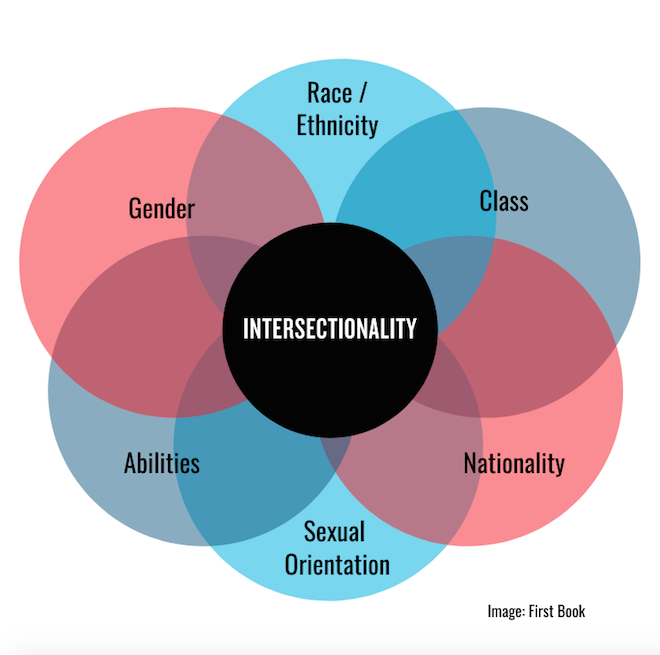
Ultimately, intersectionality also ties into the four "I"s of oppression. Intersectionality demonstrates how one's identities can intersect, as each person has multiple facets of identity that help to define who they are. This applies to the four "I"s of oppression because individuals who are part of marginalized groups are forced to be acutely aware of intersectionality, and how their identities apply to intersectionality. In contrast, individuals who are not part of marginalized groups have the option to ignore intersectionality, which acts as another form of privilege.
Wednesday, September 11, 2024
Post 2- Lisa Delpit
Lisa Delpit- Other People's Children
"Other People's Children" by Lisa Delpit dives into the struggles and obstacles that exist when trying to create classroom environments that promote cultural diversity. At the beginning of the reading, Delpit explains the idea of "The Silenced Dialogue." She utilizes multiple examples to describe how people of color will have their voices be disregarded or ignored, and focuses on how this applies in education settings. For example, one teacher explains how her words seem to go in one ear and out the other when she has discussions regarding how to best serve students of colors with her coworkers, who are predominantly white teachers. "No, they listen, but they don't hear - you know how your mama used to say you listen to the radio, but you hear your mother? Well they don't hear me" (Delpit 21). Similarly, a black woman who works as a school principal and is also a doctoral student explains "I try to give them my experiences, to explain. They just look and nod. The more I try to explain, they just look and nod, just keep looking and nodding. They don't really hear me" (Delpit 22). Ultimately, silencing people of color in these discussions greatly harms students and teachers and drastically effects student learning. It sets society back from being able to have these important discussions and change the way society functions. Therefore, it is crucial that those who experience privilege recognize that there is always more to learn, and in order to learn one must be willing to truly hear what others have to say.
Further into the reading, Delpit continues to emphasize how disparities within the classroom can negatively effect students. She also explains that although students must be taught how to navigate through a society that values the dominant culture, it is crucial students recognize and value their own culture. "The answer is to accept students but also take responsibility to teach them" (Delpit 38). It is important to teach students how to make sense of the power realities that exist within society so that they will then be able to change these realities for the better.

Friday, September 6, 2024
Post 1- Alan Johnson
Alan Johnson- Privilege, Power, and Difference
One of the biggest takeaways I had from reading the chapters by Johnson was how if we as a society do not confront the problem at hand regarding social disparities, we will never be able to find a solution. When describing how the obstacles presented to those of minorities is connected to the fortune of those with privilege, Johnson states that "It pretends we can talk about 'up' without 'down' or that a 'you' or a 'them' can mean something without a 'me' or an 'us'" (Johnson 10). In other words, it is crucial that those who benefit from privilege recognize their role in helping to be part of the solution. In order to fix the problem at hand, we must come face to face with the obstacles we encounter before we can make steps toward making a peaceful, unified society.
Furthermore, I found the segment at the end of the reading in which Johnson lists different examples of what privilege looks like in everyday life to be very insightful and thought provoking. It allowed me to think about similar situations I have seen through social media, the news, or experiences I have witnessed in my own life. The ideas presented in the reading also connected directly with S.C.W.A.A.M.P. If one does not identify with the dominant ideologies present within our culture, it is unfortunately likely that they will experience obstacles that those who "fit the standard" will never have to face. When one finds themselves to be part of some of these dominant ideologies, it is important to recognize that they may be gaining privilege from it before any solutions can be found, because to recognize a problem is to also recognize that a solution can be created.

Subscribe to:
Comments (Atom)
About Me
Post 11- Recap
Throughout the semester, we have read many articles, watched insightful videos, and discussed meaningful topics pertaining to education. Man...

-
In the reading, Sleeter emphasizes the importance of incorporating ethnic studies into curricula. One thing that stuck out to me while readi...
-
Throughout the semester, we have read many articles, watched insightful videos, and discussed meaningful topics pertaining to education. Man...
-
The 4 "I"s of Oppression / Intersectionality 101 The reading explains that there are four defining aspects of oppression: 1. Inte...


