Tuesday, October 22, 2024

Post 7-Literacy with an Attitude Argument

In "Literacy with an Attitude" by Patrick J. Finn, Finn highlights the distinctions between schools in which the student population is predominantly "executive elite," "affluential professional," "middle-class," or "working-class." He explains how despite being subject to the same state requirements, there were still stark differences separating the schools. 

In the working-class school, Finn describes how knowledge was separated from experience. He goes on to say that "Teachers rarely explained why work was being assigned or how it was connected to other assignments. Work was often evaluated in terms of whether the steps were followed rather than whether it was right or wrong" (Finn 10). Often, rules were presented without being supported by any explanation as to why the rules were instituted in the first place. Students were described by teachers as lazy and uninterested in class material, and were not given the capacity for creativity and self expression.

Compared to the working-class school, the middle-class school relied heavily on textbooks. The main goal was to "gain knowledge" rather than to fully understand that knowledge. Following directions was emphasized and thought to lead to the correct answer; however, like the working class schools, creativity was still on the back burner. "Lessons that explicitly called for creativity and self expression were 'enrichment' and 'for fun.' They did not count toward grades" (Finn 14). The idea of possibility was fundamental in these schools.

In the affluent professional school, creativity and personal development were central, unlike in the working-class and middle-class schools. It was important that students discover and connect their experiences with their knowledge rather than simply take in information. Furthermore, work was not mechanical, but rather the idea of being able to manipulate symbolic capital.

Finally, in the executive elite school, reasoning and problem solving were prioritized. Furthermore, unlike in the other 3 schools, children were given the opportunity to plan lessons and teach them to other students in the class. Generally, the students were given more freedoms than the students from the other 3 schools, such as being able to leave the classroom without permission, being in charge of the school office at lunch time, and could take materials from closets and the teacher's desk when needed. The idea of students having choice was emphasized, with phrases such as "It's up to you" acting as reminders to students.


Thursday, October 10, 2024

Post 6- What to Look for in a Classroom Reflection

When looking at Kohn's chart listing what to look for in a classroom, I reflected on the numerous classrooms I have been in throughout my years of schooling and tried to compare the physical aspects of the classroom with my own feelings on the class itself. One of the list's many details that stuck out to me the most was the "Sounds" section of the chart, which emphasizes an importance in having students explore and exchange ideas. This section also frowns upon frequent and prolonged periods of silence as well as the teacher's voice being the loudest and most heard. Throughout all my years of schooling, I have found that the classes I dreaded the most were the ones in which the teacher would read off of a powerpoint for the entire class while the students remained silent and wrote down notes. I would practically count the seconds waiting for class to end as the teacher would drone on and on about notes I could not care less about. In those same exact classes, with the same exact "boring" material, I would look forward to discussions or group work because it engaged me in a way that the notes could never compare. In other words, as Kohn suggests in the chart, classrooms must promote a learning environment where students can act as leaders in their own learning and explore new ideas with one another. A classroom in which the students are doing most of the discussion and where the teacher acts as a facilitator is more optimal than a classroom in which the teacher is the only voice that can be heard. 


Wednesday, October 2, 2024

Post 5- Troublemakers Reflection

The preface of the reading describes students who are considered "troublemakers" by teachers to be the "canaries in the mine." The author argues that students who demonstrate challenging behavior and may not always cooperate are often punished and reprimanded for wanting to exercise their freedom, for not conforming to an education system that "poisons the air" and can often do more harm than good. There is a tendency within schools to automatically mark misbehavior as the child's fault, as the child's choice to be defiant and not follow the rules. We do not consider that perhaps there is a problem with the demands we are placing on students or the format of school itself. Therefore, as future teachers, we must strive to put ourselves in our students' shoes and realize that not every method of teaching is going to work for every student. The education system has its flaws, and we must acknowledge these flaws in order to find a solution.

I can still recall the students who were deemed "the troublemakers" of the class when I was in elementary school. As a young child, when I saw these students being reprimanded for talking out one too many times or being punished for not sitting still or paying attention, I quickly learned that if I did not want to be yelled at or shamed in front of the entire class then I needed to be silent. I realized that I needed to be obedient if I did not want to go to the principal's office, and as a result I was afraid to make any kind of mistake or go against the teacher's wishes. These children in my elementary school were not simply "troublemakers," but students who most deeply felt the repercussions from being confined by the harsh structure of the education system. Rather than finding a solution that did not involve dragging the students down further, the teachers unintentionally assisted in dragging these students down by forcing them to conform to an education system that does not fit their needs, thereby silencing their voices. This "my way or the highway" approach to education ignores that students are multifaceted individuals with unique backgrounds and traits that will alter the ways in which they learn best. 


Wednesday, September 25, 2024

Post 4-The Academic and Social Value of Ethnic Studies

In the reading, Sleeter emphasizes the importance of incorporating ethnic studies into curricula. One thing that stuck out to me while reading was the opening paragraph, which talked about a man named Carlos and how his life was impacted by the Chicano studies courses at his community college. Although he graduated from high school, he was not interested in continuing his education until a friend informed him of the Chicano studies courses and encouraged him to attend. After enrolling into these courses, Carlos felt more inspired than ever to further his education, earning his BA in Spanish and hoping to teach. This introduction, as well as the entire reading, reminded me of the video "Precious Knowledge" that our class had to watch for our video analysis assignment. In the video, many of the students enrolled in the ethnic studies program in Arizona found that the classes gave them a place where they felt belonged and understood. These programs also helped them to become more engaged in class because they felt they were learning in relation to their own cultures. In the video, one student states "You pick up a history book and you don't really see any other cultures in there but, you know, mostly Caucasian white people." Similarly, the reading explains how ethnic studies programs offer students the opportunity to learn from a curriculum that breaks away from the Eurocentric curriculum that so often disregards racial and ethnic minorities. As the author puts it,"By the time they reach high school, students of color are not only aware of a Euro-American bias in curriculum, but they can describe it in some detail, and view it as contributing to their disengagement" (Sleeter 4). It is important to acknowledge how a curriculum based on only Euro-American ideas can heavily contribute to disengagement among students belonging to minorities and to recognize that incorporating ethnic studies into curricula will ultimately bring more students to develop a better relationship with education as a whole, like it did for Carlos as well as the students in the "Precious Knowledge" video. 


Wednesday, September 18, 2024

Post 3- The 4 "I"s of Oppression & Intersectionality 101

The 4 "I"s of Oppression / Intersectionality 101 

The reading explains that there are four defining aspects of oppression:

1. Internalized oppression (individually)

2. Interpersonal oppression (socially) 

3. Institutional oppression (how oppression is reinforced) 

4. Ideological oppression (how oppression perpetuates across time & space)


Each of these four "I"s can apply within education settings. For example, internalized oppression refers to how belief systems are internalized and contribute to feelings of either false supremacy or false deficiency. One instance in which internalized oppression could possibly be seen manifesting in schools is when, for instance, a student, who is also a person of color, feels pressured to over-achieve in order to be valued by their classmates and teachers. They may feel a need to go above and beyond because of the fear that they may not be truly seen otherwise. Another example of internalized oppression in schools could be when a white teacher is wrongfully doubtful of a student's intelligence solely due to race, economic status, etc. 

On the other hand, interpersonal oppression describes how internalized oppression is then expressed, whether that be intentionally or accidentally. This can include violence, comments, and other expressions between groups and individuals that result in the target feeling dehumanized. In schools, this might manifest in the form of students bullying other students for not belonging to the dominant culture. 

Institutional oppression explains how oppression occurs through social practices, including policies and laws. The reading even describes an example pertaining directly to education settings: "One example is the practice among many colleges of requiring a minimum college entrance exam score from successful candidates... As a policy and practice, test scores inequitably keep low income - particularly Black, Indigenous, or other people of color - students from accessing educational credentials and related job opportunities" ("The Four 'I's of Oppression" 3). 

Finally, ideological oppression refers to the systems rooted deep within our society that allow people to dehumanize individuals and groups. Ideological oppression overarches individual, interpersonal, and institutional oppression. Therefore, examples of ideological oppression in school settings could also fall under individual, interpersonal, and institutional oppression.

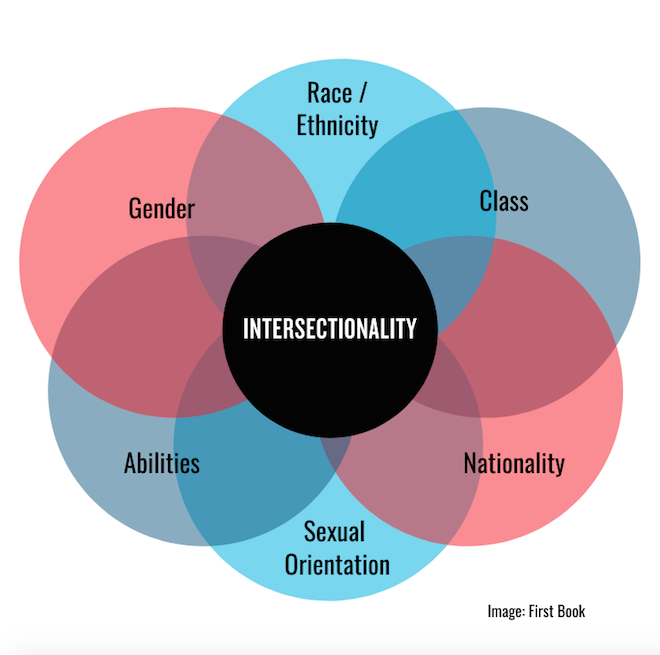
Ultimately, intersectionality also ties into the four "I"s of oppression. Intersectionality demonstrates how one's identities can intersect, as each person has multiple facets of identity that help to define who they are. This applies to the four "I"s of oppression because individuals who are part of marginalized groups are forced to be acutely aware of intersectionality, and how their identities apply to intersectionality. In contrast, individuals who are not part of marginalized groups have the option to ignore intersectionality, which acts as another form of privilege.


Intersectionality and Mental Health — NAMI Dane County


Wednesday, September 11, 2024

Post 2- Lisa Delpit

 Lisa Delpit- Other People's Children

"Other People's Children" by Lisa Delpit dives into the struggles and obstacles that exist when trying to create classroom environments that promote cultural diversity. At the beginning of the reading, Delpit explains the idea of "The Silenced Dialogue." She utilizes multiple examples to describe how people of color will have their voices be disregarded or ignored, and focuses on how this applies in education settings. For example, one teacher explains how her words seem to go in one ear and out the other when she has discussions regarding how to best serve students of colors with her coworkers, who are predominantly white teachers. "No, they listen, but they don't hear - you know how your mama used to say you listen to the radio, but you hear your mother? Well they don't hear me" (Delpit 21). Similarly, a black woman who works as a school principal and is also a doctoral student explains "I try to give them my experiences, to explain. They just look and nod. The more I try to explain, they just look and nod, just keep looking and nodding. They don't really hear me" (Delpit 22). Ultimately, silencing people of color in these discussions greatly harms students and teachers and drastically effects student learning. It sets society back from being able to have these important discussions and change the way society functions. Therefore, it is crucial that those who experience privilege recognize that there is always more to learn, and in order to learn one must be willing to truly hear what others have to say.

Further into the reading, Delpit continues to emphasize how disparities within the classroom can negatively effect students. She also explains that although students must be taught how to navigate through a society that values the dominant culture, it is crucial students recognize and value their own culture. "The answer is to accept students but also take responsibility to teach them" (Delpit 38). It is important to teach students how to make sense of the power realities that exist within society so that they will then be able to change these realities for the better. 


Friday, September 6, 2024

Post 1- Alan Johnson

Alan Johnson- Privilege, Power, and Difference

One of the biggest takeaways I had from reading the chapters by Johnson was how if we as a society do not confront the problem at hand regarding social disparities, we will never be able to find a solution. When describing how the obstacles presented to those of minorities is connected to the fortune of those with privilege, Johnson states that "It pretends we can talk about 'up' without 'down' or that a 'you' or a 'them' can mean something without a 'me' or an 'us'" (Johnson 10). In other words, it is crucial that those who benefit from privilege recognize their role in helping to be part of the solution. In order to fix the problem at hand, we must come face to face with the obstacles we encounter before we can make steps toward making a peaceful, unified society.

 Furthermore, I found the segment at the end of the reading in which Johnson lists different examples of what privilege looks like in everyday life to be very insightful and thought provoking. It allowed me to think about similar situations I have seen through social media, the news, or experiences I have witnessed in my own life. The ideas presented in the reading also connected directly with S.C.W.A.A.M.P. If one does not identify with the dominant ideologies present within our culture, it is unfortunately likely that they will experience obstacles that those who "fit the standard" will never have to face. When one finds themselves to be part of some of these dominant ideologies, it is important to recognize that they may be gaining privilege from it before any solutions can be found, because to recognize a problem is to also recognize that a solution can be created. 


About Me

Post 11- Recap

Throughout the semester, we have read many articles, watched insightful videos, and discussed meaningful topics pertaining to education. Man...